More security
through digitalisation
in our harbours
With the German Ports Secure Release Order, the collection processes are
of the German seaports digitised, standardised and secured.
German Ports Secure Release Order
German Ports: Our vision
German Ports is shaping a secure, transparent and digital future for container handling in German seaports. With a standardised digital approval process, we create transparency, increase security and create a reliable basis for future-proof port logistics.

Live info
Secure Release Order
Stage 2 -Changes at the end of March 2026
German Ports will launch Stage 2 of the Secure Release Order process at the end of March 2026.
With this second stage, the security measures will be further tightened in line with legal requirements.
Start dates:
- Hamburg: from 23 March 2026
- Bremerhaven: from 25 March 2026
- Wilhelmshaven: Date to follow
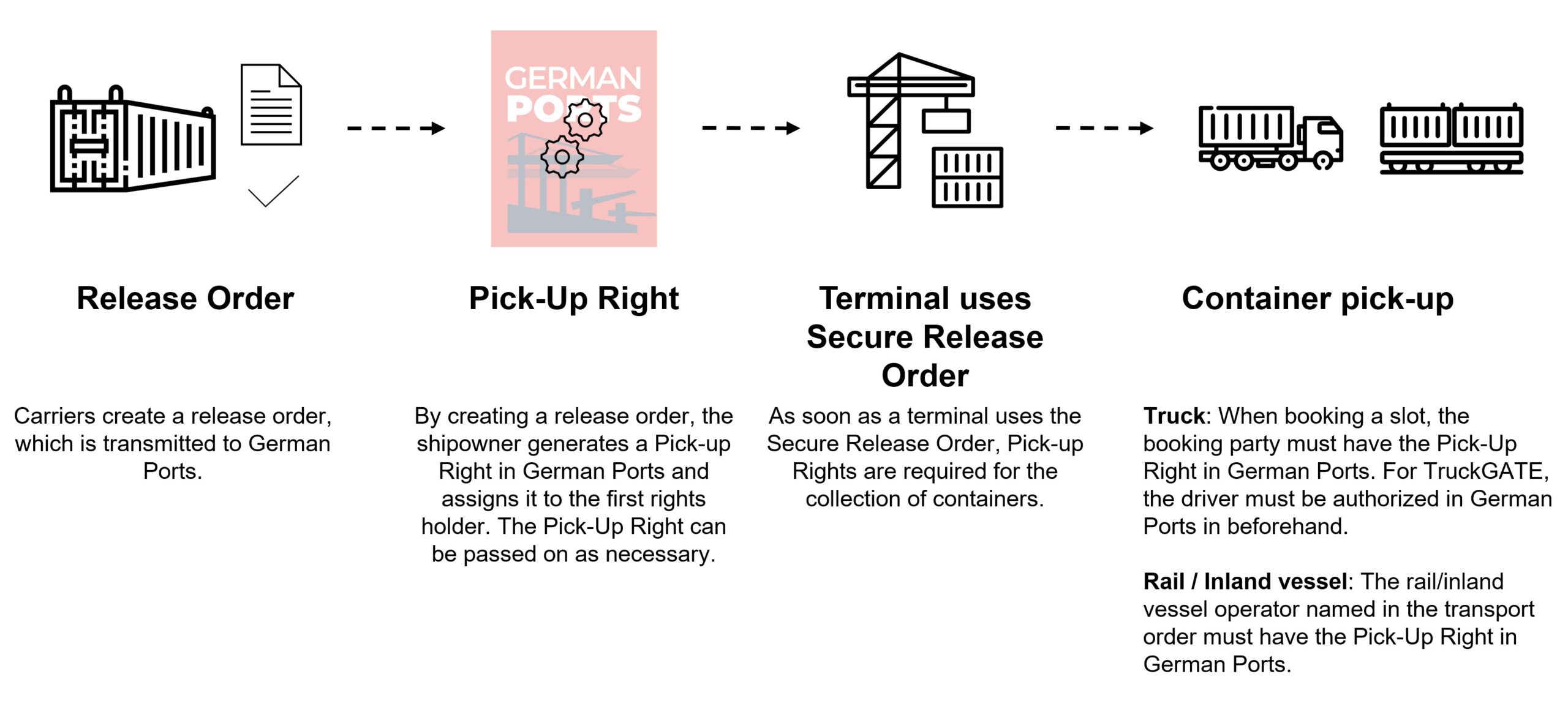
From the respective start date, an additional verification will be carried out during full container pick-up at the terminals to confirm
whether the collecting company is in possession of the active Pick-Up Right in German Ports.
In the case of TR02 slot bookings, an additional check will be performed upon arrival at the terminal to verify
whether the driver is assigned to the company with the active Pick-Up Right in the IDP systems (Impala, Conroo, Passify).
Further links to the company-driver assignments in the IDP systems can be found here.
Go Live Planning Terminals
| Location | Terminal | What is needed for the collection process? | Level 2 Date |
| Hamburg | HHLA CTA | „Downgrade to PIN“ function (switch-off date: 14/04/2026) Collection right via Secure Release Order (from 14/04/2026) |
14.04.2026 |
| Hamburg | HHLA CTB |
Right of collection via Secure Release Order |
23.03.2026 |
| Hamburg | HHLA CTT | Right of collection via Secure Release Order | 23.03.2026 |
| Hamburg | EG CTH | Right of collection via Secure Release Order | 23.03.2026 |
| Hamburg | C. Steinweg SWT | Right of collection via Secure Release Order | 24.03.2026 |
| Bremerhaven | NTB | Right of collection via Secure Release Order | 25.03.2026 |
| Bremerhaven | EG CTB | Right of collection via Secure Release Order | 25.03.2026 |
| Wilhelmshaven | EG CTW | Right of collection via Secure Release Order or Function „Downgrade to PIN“ (switch-off date to follow) | Date to follow! |

Status updates
Live system
Maintenance window:
Daily: 7:30 a.m. – 8:00 a.m.
Customer test system
Maintenance window:
daily: 07:30-8:00, 12-12:30, 16-16:30
How the Secure Release Order works
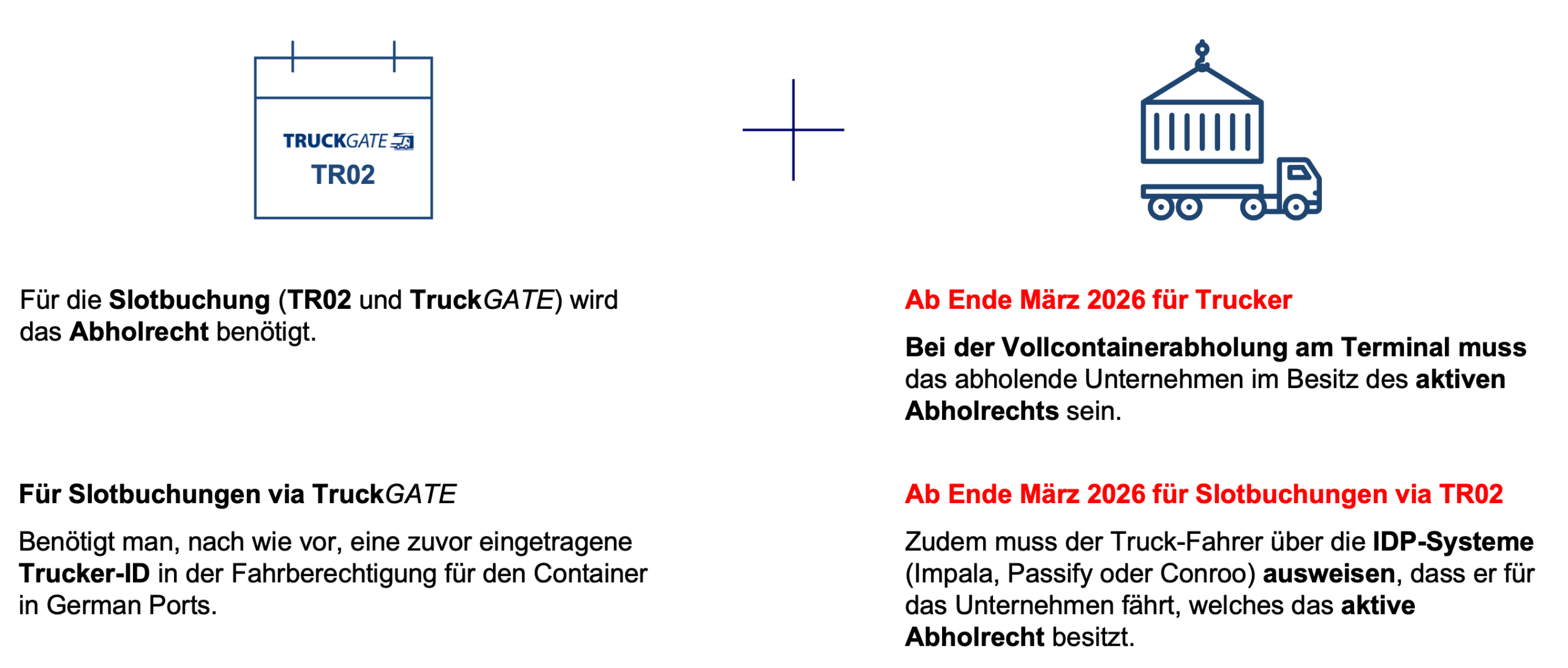
With the introduction of the Secure Release Order, a digital pick-up authorisation is now required on the German Ports platform for a container pick-up. This affects all major seaports in Germany: Hamburg, Bremerhaven and Wilhelmshaven
Secure Release Order: Stage 2 - changes at the end of March 2026
In line with the legal requirements, full container collection by truck will be further optimised at the end of March 2026, making it even safer for everyone involved in the process.
Roles and involved parties


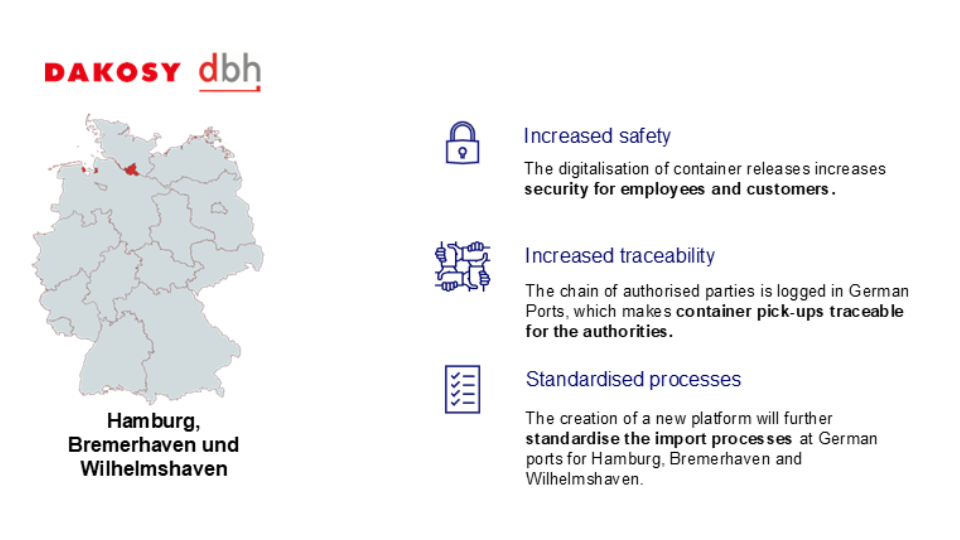
Advantages of the Secure Release Order
DAKOSY & dbh are creating a secure, standardised collection process in accordance with the requirements of the Port Security Act through Secure Release Order (SRO).
FAQs German Ports
About German Ports
German Ports is pursuing the goal of making the collection process for import containers in the German seaports of Bremerhaven, Hamburg and Wilhelmshaven more secure. A standardised, digital collection process is to replace the current exemption PIN with a pin-free, digital collection authorisation. A standardised process that is not only used at all locations, but also by all economic operators in the supply chain, should also strengthen the attractiveness of German seaports in international competition.
Commissioning will begin on 1 October 2025 and will take place in stages.
Registration, organisation and preparation
To be able to use the new digital exemption procedure, companies can first register at Registration for participation in German Ports - German Ports register. They will then receive the contract documents. As soon as DAKOSY or dbh logistics IT receives these signed documents, the technical connection and activation on the web platforms (German Ports, IMP, BIT) can take place.
Firstly, you need to register your company in German Ports via Registration - German Ports - Borderless harbour flow register. Your designated administrators can then set up various branches and user accounts on the platform. Further information can be found in the associated User guide.
2 admin users can be set up per client.
Admin users can only be changed via Support. Please create the user you want to use as an admin yourself. Then please let Support know which user you want to use as an admin. If you already have two admin users, please also let us know which user's admin rights are to be withdrawn.
We are currently receiving a large number of registrations, which we are processing one after the other as quickly as possible. We therefore ask for your patience. You will receive your contract documents in the next few days and the corresponding access data to German Ports after signing the contract.
Whether the consignee must be registered with German Ports as the rights holder depends on how the cooperation between consignee and forwarder is contractually regulated - in particular, who is to assume the right of indemnity according to the assignment agreement.
In practice, there are usually two options:
- The consignee manages the exemption himself. In this case, the consignee receives the right of collection directly via German Ports and only instructs the freight forwarder to collect the goods. Consequence: The consignee must be registered and can then pass on the collection right to the freight forwarder.
- The freight forwarder assumes the indemnity in his own name. In this case, the right of indemnity is transferred from the consignee to the freight forwarder by means of an assignment agreement, so that the freight forwarder manages the indemnity independently. Consequence: In this case, the freight forwarder must be registered.
To summarise: Those who have to register are not from the system specifications of German Ports, but depends on the contractual distribution of roles between consignee and forwarder. The decisive factor is who should ultimately receive and manage the collection right.
German Ports itself does not manage any assignment agreements and is not involved in any contractual constellations. The platform serves exclusively to provide collection rights and to enable their transfer.
We recommend that freight forwarders and transport companies allow sufficient time to realise the IT setup and try out the new processes as part of the test phase. The prerequisite for a successful implementation process is that the companies have first harmonised their internal processes with the new exemption process. In addition, a central contact person must be appointed to coordinate the exchange of information with German Ports. Freight forwarders with their own TMS can connect their interfaces (API / EDI) to German Ports. Here it is important to check in advance which adjustments are required in the TMS and to prepare these accordingly.
Technology, utilisation and costs
You can use German Ports both via an interface and via the web application. Please specify which form of connection you require when registering.
Legacy codes are your user codes in the respective in-house systems of dbh and/or DAKOSY for the CODIS or TR02 applications. They are used when you carry out the rights check against German Ports via the in-house systems. IMPORTANT: If you are not registered in TR02 or CODIS and therefore not a user of these systems, you do not have any legacy codes! Accordingly, ignore this entry. How the registration works is explained in our tutorials.
Partner codes are the identification numbers under which you are listed as a customer of the shipping company. To do this, you need to liaise with your shipowners! If a shipping company assigns collection rights via the partner codes, you must ask the shipping company for your partner code and link it to your German Ports ID accordingly. How the registration works is explained in our tutorials.
Whether you have to enter partner codes in German Ports depends on the specifications of the respective carrier. If your carrier works with partner codes in German Ports, these must be entered in German Ports. If your carrier does not use partner codes and uses German Ports IDs instead, you do not need to enter any partner codes. Please always follow the communication and specifications of your respective carrier.
A basic monthly fee of € 60.00 per contractual partner (DAKOSY for Hamburg, dbh for Bremerhaven and Wilhelmshaven) is charged for the use of German Ports. In addition, the following costs are charged on a case-by-case basis:
- Creation of a collection right: € 0.80 per creation
- Activation of a pick-up right: € 0.80 per activation
- Forwarding a pick-up right: € 0.40 per forwarding
- Requesting a collection right: € 0.39 per exempted container
Further information can be found here: Prices - German Ports
Security, operation and support
The system is secured across several levels - including through proven cloud and Azure mechanisms such as redundancy, regular backups with recovery options, continuous monitoring and rapid response in the event of a fault.
In the event of a system failure (German Ports/TR02/IDP systems), no documentation of the deliveries needs to be added.
The time of system outages is shown in German Ports for the users of the authorities.
You will receive further information from our webinars here. User-specific information, documentation & guides can also be found on the German Ports website under the menu item Roles to view. We will also be providing video tutorials in the coming weeks explaining how to use the application.
For further questions please use our Contact form for the port in question or call us on +49 421 30902810 for Bremerhaven & Wilhelmshaven or +49 40 37860970 for Hamburg.
News and events
Launch of the "Secure Release Order"
30 August 2025 | From 1 October 2025, a standardised digital release process called "Secure Release Order" will be introduced for all container imports via the German seaports of Bremen, Bremerhaven and Hamburg. The joint project between dbh Logistics IT AG and DAKOSY Datenkommunikationssystem AG stands for a secure, [...]
New IT to secure northern German ports against container theft
30 July 2025 | Bremerhaven, Wilhelmshaven and Hamburg are upgrading their ports. A new IT system is to make container theft and drug smuggling more difficult from October. Until now, anyone wishing to remove a container from the harbour site has needed a four-digit pin code. Shipowners, terminal employees, freight forwarders and lorry drivers receive this code, sometimes in unencrypted form. A procedure that [...]
"Secure Release Order" aims to prevent container theft in German ports
30 July 2025 | Digital instead of telephone: German ports rely on a standardised system to prevent unauthorised container collection. To prevent container theft and misuse of container release, German container ports are introducing a new security procedure on 1 October. Read more here Source: HANSA International Maritime Journal / Schiffahrts-Verlag Hansa [...]
German container ports join forces against container theft
29 July 2025 | Bremen Freight Forwarders Association sees strengthening of German container ports. Increasing cybercrime and drug smuggling are a threat to the importing economy and freight forwarders. Time and again, criminals try to get import containers delivered from the container terminals. Up to now, all that has been required is a four-digit PIN number, for example, [...]
German Ports at transport logistic 2025 - DVZ's Red Sofa with Marco Molitor and Ulrich Wrage
05 June 2025 | At transport logistic 2025 in Munich, numerous top-class logistics managers once again took a seat on the famous red DVZ talk sofa. These included Marco Molitor, CEO of dbh Logistics IT AG, and Ulrich Wrage, CEO of DAKOSY Datenkommunikation AG. On the important topic of [...]
With German Ports to the safe harbour - questions and answers on digital exemption
03 June 2025 | A standardised digital release process for container imports via German seaports is being launched under the name "Secure Release Order". DAKOSY has compiled everything you need to know about the new process and answers important questions on the topic. Why is the release process currently in the spotlight? With the [...]