More security
through digitalisation
in our harbours
With the German Ports Secure Release Order, the collection processes are
of the German seaports digitised, standardised and secured.
German Ports Secure Release Order
German Ports: Our vision
German Ports is shaping a secure, transparent and digital future for container handling in German seaports. With a standardised digital approval process, we create transparency, increase security and create a reliable basis for future-proof port logistics.

Status updates
Live system
Maintenance window:
Daily: 7:30 a.m. – 8:00 a.m.
Customer test system
Maintenance window:
daily: 07:30-8:00, 12-12:30, 16-16:30
How the Secure Release Order works
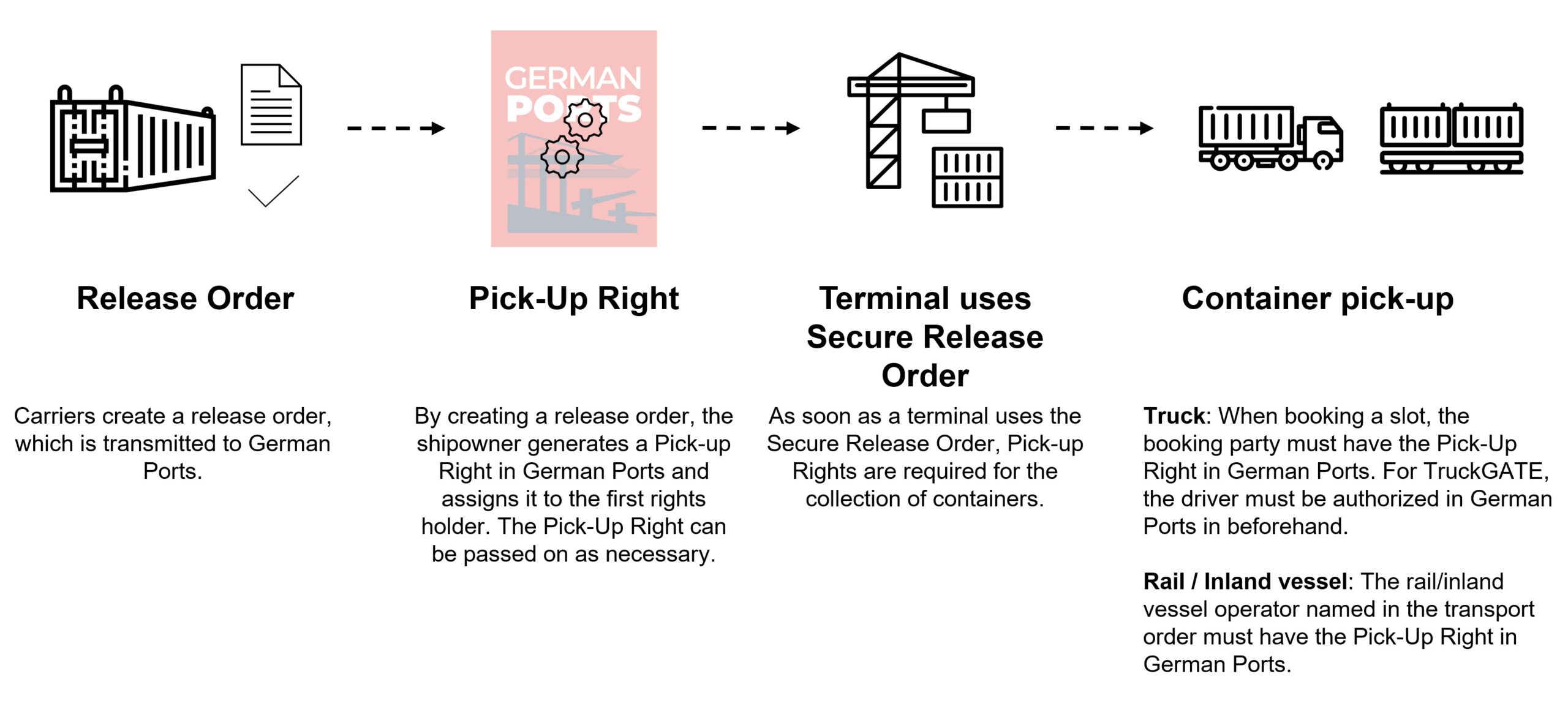
With the introduction of the Secure Release Order, a digital pick-up authorisation is now required on the German Ports platform for a container pick-up. This affects all major seaports in Germany: Hamburg, Bremerhaven and Wilhelmshaven
Roles and involved parties



Advantages of the Secure Release Order
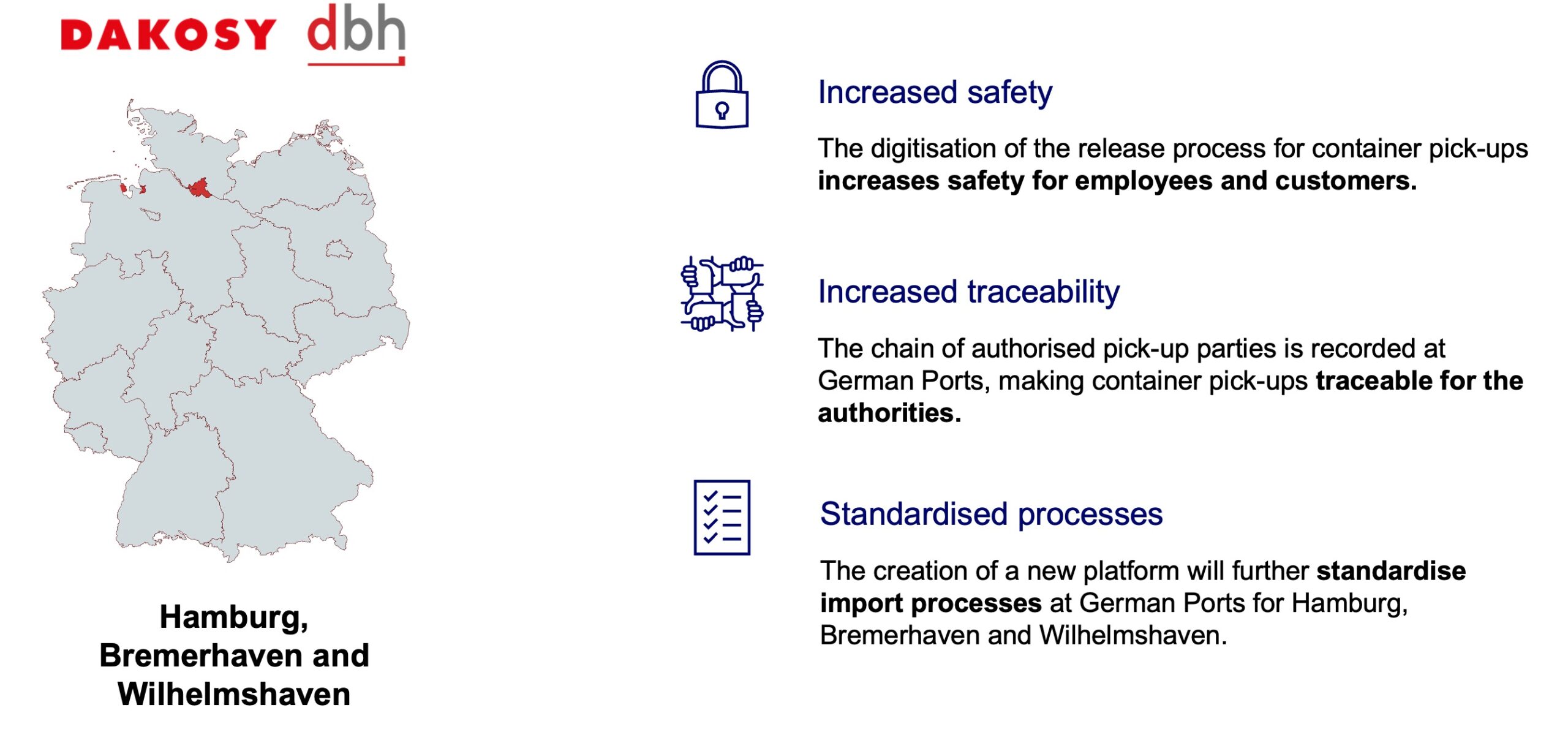
DAKOSY & dbh are creating a secure, standardised collection process in accordance with the requirements of the Port Security Act through Secure Release Order (SRO).
FAQs German Ports
About German Ports
German Ports is pursuing the goal of making the collection process for import containers in the German seaports of Bremerhaven, Hamburg and Wilhelmshaven more secure. A standardised, digital collection process is to replace the current exemption PIN with a pin-free, digital collection authorisation. A standardised process that is not only used at all locations, but also by all economic operators in the supply chain, should also strengthen the attractiveness of German seaports in international competition.
Registration, organisation and preparation
To be able to use the new digital exemption procedure, companies can first register at Registration for participation in German Ports - German Ports register. They will then receive the contract documents. As soon as DAKOSY or dbh logistics IT receives these signed documents, the technical connection and activation on the web platforms (German Ports, IMP, BIT) can take place.
Firstly, you need to register your company in German Ports via Registration - German Ports - Borderless harbour flow register. Your designated administrators can then set up various branches and user accounts on the platform. Further information can be found in the associated User guide.
2 admin users can be set up per client.
Admin users can only be changed via Support. Please create the user you want to use as an admin yourself. Then please let Support know which user you want to use as an admin. If you already have two admin users, please also let us know which user's admin rights are to be withdrawn.
Whether the consignee must be registered with German Ports as the rights holder depends on how the cooperation between consignee and forwarder is contractually regulated - in particular, who is to assume the right of indemnity according to the assignment agreement.
In practice, there are usually two options:
- The consignee manages the exemption himself. In this case, the consignee receives the right of collection directly via German Ports and only instructs the freight forwarder to collect the goods. Consequence: The consignee must be registered and can then pass on the collection right to the freight forwarder.
- The freight forwarder assumes the indemnity in his own name. In this case, the right of indemnity is transferred from the consignee to the freight forwarder by means of an assignment agreement, so that the freight forwarder manages the indemnity independently. Consequence: In this case, the freight forwarder must be registered.
To summarise: Those who have to register are not from the system specifications of German Ports, but depends on the contractual distribution of roles between consignee and forwarder. The decisive factor is who should ultimately receive and manage the collection right.
German Ports itself does not manage any assignment agreements and is not involved in any contractual constellations. The platform serves exclusively to provide collection rights and to enable their transfer.
Technology, utilisation and costs
You can use German Ports both via an interface and via the web application. Please specify which form of connection you require when registering.
Legacy codes are your user codes in the respective in-house systems of dbh and/or DAKOSY for the CODIS or TR02 applications. They are used when you carry out the rights check against German Ports via the in-house systems. IMPORTANT: If you are not registered in TR02 or CODIS and therefore not a user of these systems, you do not have any legacy codes! Accordingly, ignore this entry. How the registration works is explained in our tutorials.
Partner codes are the identification numbers under which you are listed as a customer of the shipping company. To do this, you need to liaise with your shipowners! If a shipping company assigns collection rights via the partner codes, you must ask the shipping company for your partner code and link it to your German Ports ID accordingly. How the registration works is explained in our tutorials.
Whether you have to enter partner codes in German Ports depends on the specifications of the respective carrier. If your carrier works with partner codes in German Ports, these must be entered in German Ports. If your carrier does not use partner codes and uses German Ports IDs instead, you do not need to enter any partner codes. Please always follow the communication and specifications of your respective carrier.
A basic monthly fee of € 60.00 per contractual partner (DAKOSY for Hamburg, dbh for Bremerhaven and Wilhelmshaven) is charged for the use of German Ports. In addition, the following costs are charged on a case-by-case basis:
- Creation of a collection right: € 0.80 per creation
- Activation of a pick-up right: € 0.80 per activation
- Forwarding a pick-up right: € 0.40 per forwarding
- Requesting a collection right: € 0.39 per exempted container
Further information can be found here: Prices - German Ports
Security, operation and support
The system is secured across several levels - including through proven cloud and Azure mechanisms such as redundancy, regular backups with recovery options, continuous monitoring and rapid response in the event of a fault.
In the event of a system failure (German Ports/TR02/IDP systems), no documentation of the deliveries needs to be added.
The time of system outages is shown in German Ports for the users of the authorities.
You will receive further information from our webinars here. User-specific information, documentation, guides & tutorials can also be found on the German Ports website under the Tutorial menu item and under the individual Roles view.
For further questions please use our Contact form for the port in question, write an e-mail to support@germanports.com or call us on the following numbers +49 421 30902810 for Bremerhaven & Wilhelmshaven or +49 40 37860970 for Hamburg.
News and events
Project completion: North Sea ports have fully digitalised container release
05 May 2026 | The software service providers DAKOSY and dbh have successfully completed the major project for the cross-port digitalisation of container release (Secure Release Order) via the German Ports IT platform. In just one year, the two companies completed the project from the registration of the first participant to the connection of all [...]
German Ports: Mandatory involvement of transport companies
18 March 2026 | The digital release for container imports via the German Ports IT platform is entering its final phase. Transport companies and lorry drivers are the last group of participants to be integrated into the process. Collecting companies must ensure that they have a valid digital collection authorisation. This enables the terminals to [...]
Free webinar -
German Ports for Freight Forwarders, Logistics Providers and Trucking Companies
| 16 March 2026 2-3 PM
We invite all freight forwarders, logistics providers and trucking companies to join our free webinar on 16 March 2026 from 14:00 to 15:00. In line with legal requirements, German Ports will soon launch Stage 2 of the Secure Release Order as planned. The objective is to further optimize container pick-up processes in [...]
Port of Hamburg switches off PIN procedure for containers
09 February 2026 | The vulnerable PIN procedure is being switched off at the Port of Hamburg. Freight forwarders must now switch to an encrypted digital system to combat smuggling. From today, freight forwarders at the Port of Hamburg must switch to a new, digital collection system. The PIN alternative known as a security gap will be deactivated at important terminals - a [...]
Free webinar -
German Ports for UNIKAT GE customers
| 17 February 2026, 14:00 - 15:00
We cordially invite all UNIKAT GE customers to a free webinar on 17 February 2026 from 14:00 - 15:00. In accordance with the legal requirements, German Ports will soon be starting stage 2 for the Secure Release Order as planned. The aim is to make container collection in the [...]
Free webinar -
German Ports for freight forwarders, logisticians and haulage companies
| 12 March 2026, from 11:00 - 12:00 a.m.
In accordance with the legal requirements, German Ports will soon be launching stage 2 of the Secure Release Order as planned, with the aim of further optimising container collection in the German seaports for all parties involved in the process and making it even more secure. The introduction of level 2 is location-dependent. The respective [...]